Colibri VF61
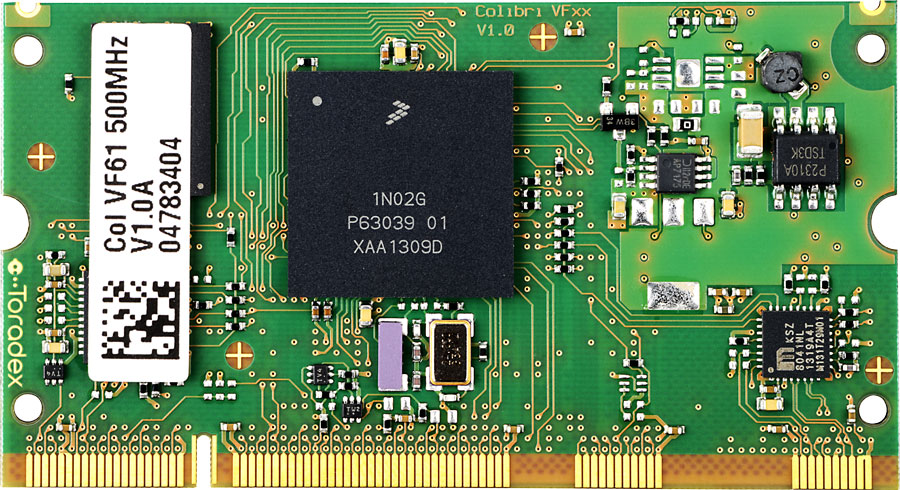
The Colibri VF61 is a Toradex System on Module based on the NXP/Freescale Vybrid VF6xx SoC, and a member of the Colibri Family.
This page provides hardware design resources, documentation, revision history, erratas, compatibility details, and getting started guides for developers working with the Colibri VF61 module.
Getting Started
Recommendation for the First-Time Order
Colibri VF61 is currently in a last-time buy phase and is approaching end-of-life (EOL). Therefore, we do not recommend starting new projects based on Vybrid platforms. Instead, we suggest using newer SoCs. For more information, please refer to the Revision History section.
Having trouble?
Please contact our technical support. Various options of technical support are mentioned below:
Product Features
Hardware Features
Compatible Products
Pinout Evaluation & Planning
Power Consumption
Product Documents
Datasheets
Colibri VF61
Design Resources
Toradex provides two different 3D models for Colibri Systems on Module:
Generic Colibri 3D Mechanical Models: This model has the maximum component height for testing the mechanical fit. This ensures the mechanical design fits all current Colibri modules as well as future releases.
- Specific Colibri 3D Mechanical Models: These models are simplified models of the respective Colibri module. They contain only the PCB and the CPU and are intended to be used for heat spreader or heat sink designs. The CPU height is a typical value. Due to production tolerances, the actual height of the assembled component can be different.
Generic Colibri 3D Mechanical Models
The generic Colibri 3D model contains the PCB and the maximum component height on top and bottom of modules from the Colibri Module Family. This model should be used to test the mechanical fit, ensuring that the mechanical design fits all current Colibri modules as well as future releases.
- SolidWorks CAD model 3D EASM model
- You can download the free eDrawings model viewer from SolidWorks here
- 3D STEP model that can be opened and modified in any 3D CAD
- 3D PDF model that can be opened in Adobe Reader
Colibri VFxx - Specific 3D Mechanical Models
The Colibri VFxx 3D model is simplified and contains only the PCB and the CPU. It is intended to be used for heat spreader or heat sink designs. The CPU height is a typical value. Due to production tolerances, the actual height of the assembled component can be different. Please use the Generic Colibri 3D Mechanical Models with the maximum component height for testing the mechanical fit. This ensures the mechanical design fits all current Colibri modules as well as future releases.
- SolidWorks CAD model 3D EPRT model
- You can download the free eDrawings model viewer from SolidWorks here
- 3D STEP models that can be opened and modified in any 3D CAD. The simplified model does not contain any copper pads.
- 3D PDF model that can be opened in Adobe Reader
Design and Layout Guide
Hardware Ecosystem
Carrier Boards
Off-the-shelf Carrier Boards
Custom Carrier Board Design
Find free reference designs, schematics, 3D designs, and tools to build your carrier board easily in the link below:
Accessories & Add-ons
- EDT Display
- Colibri Fastener
- Capacitive Touch Display 7" Parallel
- Resistive Touch Display 7" Parallel
- Carrier Board Accessory Kit
- LM816 USB WiFi
- Analogue Camera Adapter
Check other options and compatibility information on the add-ons product pages.
Software Ecosystem
Toradex-Supported Operating Systems
Industry and Partner Software Ecosystem
For detailed instructions about software development, including other operating systems for Toradex Computer on Modules - QNX, Android and more - check out our software ecosystem page:
Development Resources
Installing the Operating System
For information on how to update the module's operating system, or switch between Embedded Linux and Windows CE, see the article below:
Toradex also provides quick video tutorials on its YouTube channel:
For developing software on the platform, browse through the knowledge base articles in the link below:
Revision History
Click to See the Product Numbering Scheme
Product Number (PID8) Format
The format of the 8-digits Product Number (PID8) is the following:
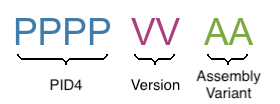
The below table describes the structure of the Product Number (PID8):
| Field | Description |
|---|---|
| PPPP | 4-digits number, indicating the Product Configuration (PID4) that describes the key properties of the product (e.g. Product Group, RAM capacity, etc.) |
| VV | 2-digits number, indicating the Major and Minor Version (in that order) |
| AA | 2-digits number, indicating the Assembly Variant |
See the complete list of available combinations on the Revision History table of the corresponding product page.
Example
Product number (PID8): 00291100:
0029: Apalis iMX6D 512MB
11: Major Version 1, Minor Version 1, Version V1.1 in short
00: Assembly Variant A
A specific product revision has a lifecycle defined by the product state. Learn more about it on the Product Change Notifications.
0011 Colibri VF61 256MB
| Product # | Product Description | Changes from Previous Version | Release Date | PCN Document |
|---|---|---|---|---|
| 00111001 | Colibri VF61 256MB V1.0B | Initial Release | 2013-12 | Sample Product, No PCN |
| 00111100 | Colibri VF61 256MB V1.1A | PCB changes due to AC97 issues | 2014-03 | Sample Product, No PCN |
0012 Colibri VF61 256MB IT
| Product # | Product Description | Changes from Previous Version | Release Date | PCN Document |
|---|---|---|---|---|
| 00121101 | Colibri VF61 256MB IT V1.1B | Changed Product number to 0012 (IT version) Using industrial temperature range parts only | 2014-04 | PCN Colibri VF61 256MB IT V1.1B 2015-03-18 |
| 00121200 | Colibri VF61 256MB IT V1.2A | Hardware change to enable RAM self-refresh mode required for suspend mode (LPStop in Linux) | 2015-03-18 | PCN Colibri VF61 256MB IT V1.2A 2017-12-15 |
| 00121201 | Colibri VF61 256MB IT V1.2B | Changed NAND flash from Macronix MX30LF4G28AB-TI to MX30LF4G28AC-TI | 2018-01-15 | EOL PCN Colibri VF61 256MB IT |
Errata/Known Issues
SoC Errata Document
- Filter by
Errataon the VF6xx Documentation on the NXP website.