Ixora Carrier Board
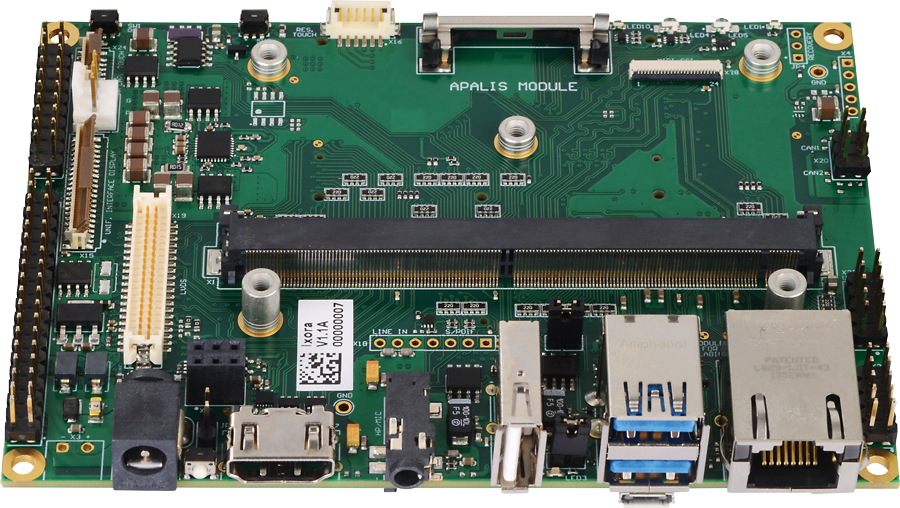
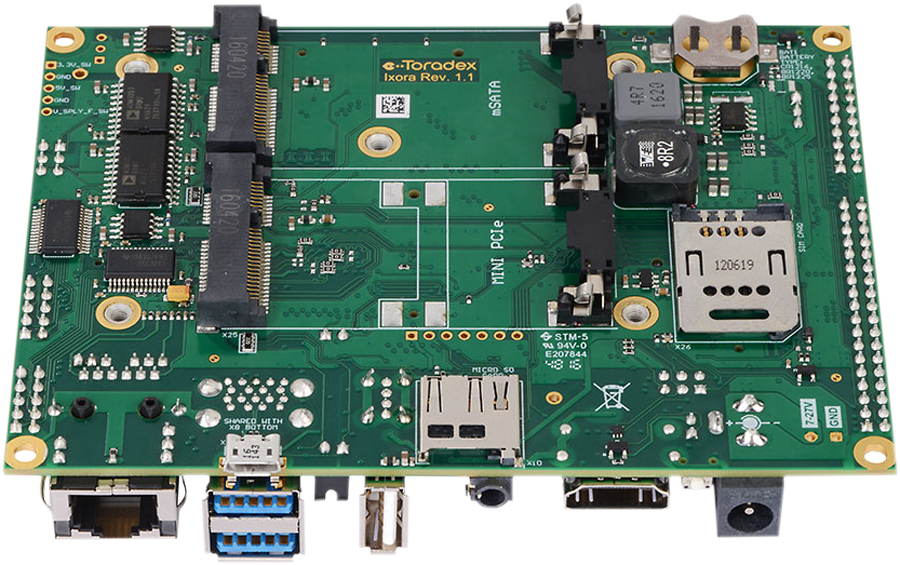
The Ixora Carrier Board is a carrier board that gives you easy access to a selected set of the interfaces of the Apalis System on Modules (SoMs), intended as a production platform.
Pair the Ixora Carrier Board with your choice of Apalis System on Module (SoM) for a validated, production-ready Single-Board Computer (SBC), available in volume with long-term availability and support. The board and module are supplied separately for you to assemble.
For a custom version, Toradex Solutions can populate fewer features on the same PCB or design a new board based on it.
Free design resources also let you customize the board yourself, starting from a validated, supported design.
This page provides hardware design resources, documentation, revision history, erratas, compatibility details, and getting started guides for developers working with the Apalis SoM family.
Getting Started
Recommendation for the First-Time Order
Toradex recommends ordering the following additional products for your first-time order:
All products are available for online purchase through the Toradex Webshop.
Quickstart Guide
Check out our guide for detailed instructions on how to get your board up and running with Torizon:
Having trouble?
Please contact our technical support. Various options of technical support are mentioned below:
Product Features
Hardware Features
Compatible Products
Learn more on the Apalis Product Family Specification.
Accessories & Add-ons
- Apalis Heatsink
- Carrier Board Accessory Kit
- Apalis iMX6 Mezzanine
- Apalis T30 Mezzanine
- Analogue Camera Adapter
- Capacitive Touch Display 7" Parallel [1]
- Resistive Touch Display 7" Parallel
- Capacitive Touch Display 10.1" LVDS
- EDT Display
- LM816 USB WiFi
- CSI Camera Module 5MP OV5640 - for Ixora V1.1A and newer
[1] For Ixora V1.0A, the Capacitive Touch Adapter is required. V1.1A and above are directly compatible.
Check other options and compatibility information on the add-ons product pages.
Block Diagram
Pinout Evaluation & Planning
Product Documents
Datasheets
Ixora Carrier Board V1.3
Ixora Carrier Board V1.2
Ixora Carrier Board V1.1
Ixora Carrier Board V1.0
Design Resources
Ixora Carrier Board Design Data V1.3
Ixora Carrier Board Design Data V1.2
Ixora Carrier Board Design Data V1.1
Ixora Carrier Board Design Data Archive
Ixora Carrier Board Mechanical Models
Ixora Carrier Board V1.3
A basic 3D model for the Ixora Carrier Board can be downloaded here:
- SolidWorks CAD model 3D EASM model
- You can download the free eDrawings model viewer from SolidWorks here
- 3D STEP model that can be opened and modified in any 3D CAD
- 3D PDF model that can be opened in Adobe Reader
Ixora Carrier Board V1.2
A basic 3D model for the Ixora Carrier Board V1.2 can be downloaded here:
- SolidWorks CAD model 3D EASM model
- You can download the free eDrawings model viewer from SolidWorks here
- 3D STEP model that can be opened and modified in any 3D CAD
- 3D PDF model that can be opened in Adobe Reader
Ixora Carrier Board V1.1
- SolidWorks CAD model 3D EASM model
- You can download the free eDrawings model viewer from SolidWorks here
- 3D STEP model that can be opened and modified in any 3D CAD
- 3D PDF model that can be opened in Adobe Reader
Ixora Carrier Board V1.0
- SolidWorks CAD model 3D EASM model
- You can download the free eDrawings model viewer from SolidWorks here
- 3D STEP model that can be opened and modified in any 3D CAD
- 3D PDF model that can be opened in Adobe Reader
Design and Layout Guide
Altium Designer
Software Ecosystem
Toradex-Supported Linux Platforms
The following Linux-based offerings are in-house supported - pre-built images available for quick evaluation:
-
Torizon OS - open source, easy to use industrial Linux operating system
-
Yocto Project Reference Images - reference images for Yocto Project, a great starting point for customized Linux images
Industry and Partner Software Ecosystem
For detailed instructions about software development, including other operating systems for Toradex Computer on Modules - QNX, Android and more - check out our software ecosystem page:
Development Resources
Installing the Operating System
Toradex products come with Toradex Easy Installer pre-installed. Once you power-on the board, it will display a list of available images to be installed. Check out how to get started with the Toradex Easy Installer:
You might need to enter recovery mode:
You can also install the compatible pre-built images available for download:
Connecting to the Board
During development, you will need to communicate the board with your host machine:
Applying Settings for your Hardware Combination
With the terminal connection to the board, select the appropriate Device Tree for your board and reboot the device. This is the main configuration needed to match your SoM to the carrier board.
# sudo fw_setenv fdtfile <som-designation>-<wifi/nonwifi>-<carrier-board-designation>.dtb
The placeholders identify the SoM, Wi-Fi variant (where applicable), and carrier board. The exact naming varies by module family.
Example for Apalis iMX6 Quad on the Ixora Carrier Board:
# sudo fw_setenv fdtfile imx6q-apalis-ixora.dtb
Refer to Device Trees on Toradex System on Modules to find the device tree for your SoM and carrier board combination. Use the corresponding .dts filename with the extension changed to .dtb.
Revision History
Click to See the Product Numbering Scheme
Product Number (PID8) Format
The format of the 8-digits Product Number (PID8) is the following:
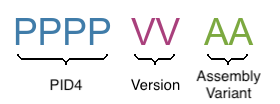
The below table describes the structure of the Product Number (PID8):
| Field | Description |
|---|---|
| PPPP | 4-digits number, indicating the Product Configuration (PID4) that describes the key properties of the product (e.g. Product Group, RAM capacity, etc.) |
| VV | 2-digits number, indicating the Major and Minor Version (in that order) |
| AA | 2-digits number, indicating the Assembly Variant |
See the complete list of available combinations on the Revision History table of the corresponding product page.
Example
Product number (PID8): 00291100:
0029: Apalis iMX6D 512MB
11: Major Version 1, Minor Version 1, Version V1.1 in short
00: Assembly Variant A
A specific product revision has a lifecycle defined by the product state. Learn more about it on the Product Change Notifications.
0133 Ixora Carrier Board
| Product # | Product Description | Changes from Previous Version | Release Date | PCN Document |
01331000 | Ixora V1.0A |
| 2013-09-26 | PCN Ixora Carrier Board V1.0A 2017-03-06 |
01331100 | Ixora V1.1A |
| 2017-03-24 | PCN Ixora Carrier Board V1.1A 2020-01-09 |
01331101 | Ixora V1.1B |
| 2019-05-07 | Interim version, no PCN. For details of changes in V1.2A, see PCN of V1.1A |
01331200 | Ixora V1.2A |
| 2020-01-09 | PCN Ixora Carrier Board V1.2A 2023-01-04 |
01331300 | Ixora V1.3A |
| Q2, 2023 |
Errata/Known Issues
Errata Document
Ixora Carrier Board Errata Document